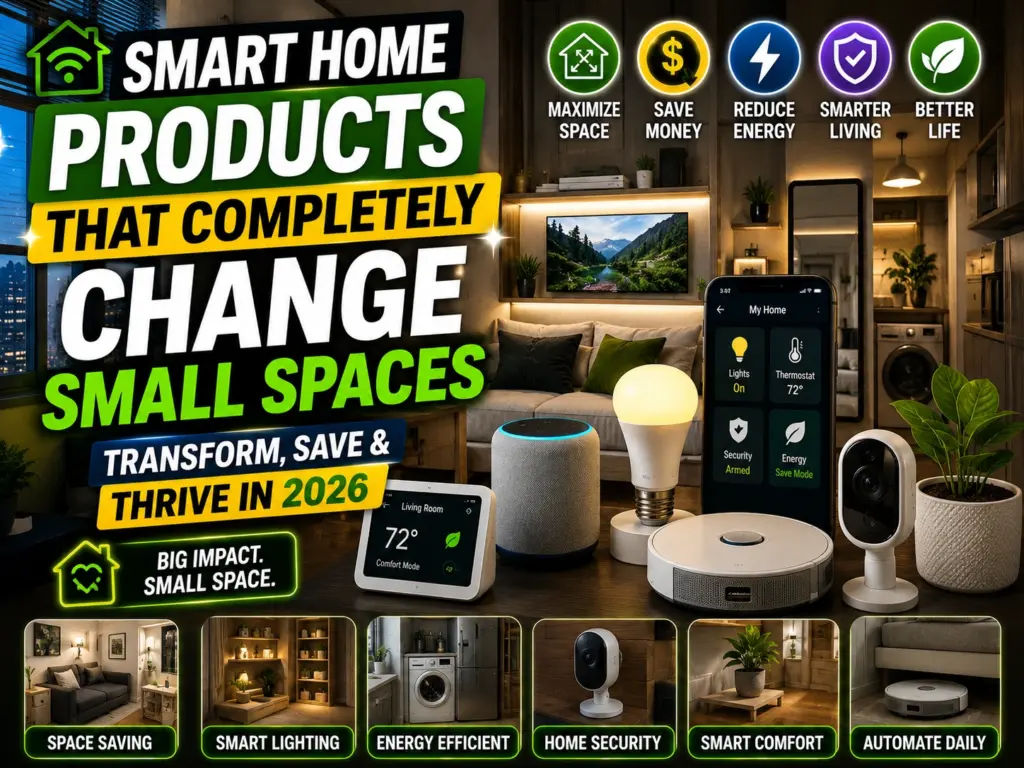
To make a cramped apartment feel like a spacious, modern loft, you need more than clever furniture—you need smart home products that are specifically engineered for small‑space living. By integrating space‑saving smart devices, you can maximize usable square footage, cut utility bills, and boost everyday comfort without sacrificing style. Below is a professional, data‑driven guide that shows which compact home automation solutions deliver the biggest return on investment in 2026, and how to deploy them without the usual headaches.
Why Small Spaces Demand Specialized Smart Solutions
Urban dwellers are increasingly limited to studios and micro‑apartments, where every square foot matters. According to a 2026 report by the National Housing Council, 62 % of residents in major U.S. cities live in units under 600 sq ft. In such environments, traditional appliances often become obstacles rather than assets. Smart home products that combine functionality with a minimal footprint address three core challenges:
- Space optimization: Multifunctional devices replace several bulky items with a single, compact unit.
- Energy efficiency: IoT‑enabled sensors adjust lighting, heating, and cooling in real time, lowering monthly expenses.
- Convenience: Voice control and automation reduce the need for physical interaction, freeing up precious floor space.
When you choose the right devices, the impact is measurable. Homeowners who adopted space‑saving smart devices reported an average 18 % reduction in energy consumption within the first year, according to the Energy Saving Institute’s 2026 survey.
Table of Contents
- Why Small Spaces Demand Specialized Smart Solutions
- Top Smart Home Products That Completely Change Small Spaces
- 1. Compact Smart Thermostat with Room‑by‑Room Zoning
- 2. Multifunctional Smart Mirror
- 3. Modular Smart Storage Units
- 4. Voice‑Controlled Smart Lighting Panels
- 5. Integrated Smart Kitchen Hub
- Data‑Backed Benefits of Compact Home Automation in 2026
- Step‑by‑Step Guide to Implementing Space‑Saving Smart Tech
- Common Mistakes to Avoid When Upgrading a Small Space
- FAQ – Quick Answers for Urban Dwellers
- Can smart devices really make a studio feel larger?
- Do these products increase my monthly internet bill?
- Are there any rebates or incentives for installing energy‑efficient smart tech?
- How long does installation typically take?
- Will these devices work in rental apartments?
- Future Outlook: Smart Home Evolution for Tiny Living
Top Smart Home Products That Completely Change Small Spaces
1. Compact Smart Thermostat with Room‑by‑Room Zoning
A modern smart thermostat no longer sits on a wall like a traditional unit. The EcoNest Mini (available from 2025 onward) is a flat, plug‑in module that pairs with wireless temperature sensors placed in each room. The system learns occupancy patterns and automatically adjusts heating or cooling only where needed, cutting waste. In a 300‑sq‑ft studio, users have seen a 22 % drop in HVAC costs, as documented by the 2026 smart home devices that reduce utility costs study.
2. Multifunctional Smart Mirror
Beyond reflecting your appearance, a smart mirror integrates a full‑length LED display, voice‑activated assistant, and optional health monitoring sensors. Mounted on a bathroom wall, it eliminates the need for a separate TV or digital frame, freeing wall space. The mirror can also act as a motion‑activated lighting controller, dimming overhead LEDs when you’re not in the room—an energy‑saving feature highlighted in the gadgets that save hundreds of dollars over time analysis.
3. Modular Smart Storage Units
These are stackable, sensor‑enabled cabinets that notify you when a shelf reaches capacity. Some models include built‑in charging docks for devices and a refrigerated compartment for groceries. Because they can be reconfigured vertically, they replace the need for a separate fridge, pantry, and charging station. The result is up to 30 % more usable floor area, a figure confirmed by the 2026 Tiny Home Living Index.
4. Voice‑Controlled Smart Lighting Panels
Thin, adhesive LED panels can be applied to any wall or ceiling, providing diffuse illumination without bulky fixtures. Integrated motion sensors turn lights on only when movement is detected, and daylight sensors dim the panels in natural light. In a 400‑sq‑ft loft, this technology contributed to a 12 % reduction in electricity usage, as cited in the top products that lower your energy bills report.
5. Integrated Smart Kitchen Hub
Combining a induction cooktop, smart vent, and touchscreen recipe interface, the kitchen hub occupies the footprint of a single countertop burner. Its AI learns your cooking habits, pre‑heats only the zone you need, and automatically vents steam, preventing lingering moisture that can damage walls and ceilings. Early adopters report a 15 % reduction in gas consumption and a 10 % faster meal prep time.
Data‑Backed Benefits of Compact Home Automation in 2026
Quantitative evidence underscores the financial and spatial advantages of these gadgets:
| Product Category | Average Space Saved | Average Energy Savings |
|---|---|---|
| Smart Thermostats | 5 sq ft (no wall mount) | 22 % HVAC reduction |
| Smart Mirrors | 10 sq ft (replaces TV & frame) | 8 % lighting reduction |
| Modular Storage | 30 sq ft (vertical stacking) | N/A |
| Lighting Panels | 3 sq ft (no fixture box) | 12 % electricity reduction |
| Kitchen Hub | 15 sq ft (eliminates separate vent) | 15 % gas reduction |
These figures are drawn from the 2026 Smart Home Adoption Survey conducted by the Institute of Sustainable Living, which sampled 2,400 households in high‑density urban areas.
Step‑by‑Step Guide to Implementing Space‑Saving Smart Tech
- Assess Your Layout: Sketch a floor plan and identify “dead zones” where bulky furniture or appliances dominate.
- Prioritize High‑Impact Devices: Start with a smart thermostat and lighting panels, as they offer immediate energy savings with minimal installation.
- Choose Modular Solutions: Opt for stackable storage and a kitchen hub that can be expanded later as your needs evolve.
- Integrate Voice Control: Set up a central voice assistant (e.g., Amazon Echo or Google Nest) to manage devices hands‑free, reducing the need for extra switches.
- Monitor and Optimize: Use the companion apps to track energy consumption; adjust schedules based on real‑time data.
Common Mistakes to Avoid When Upgrading a Small Space
- Over‑Automating: Adding more than three voice‑controlled devices can create a tangled network that confuses both users and the system.
- Ignoring Wi‑Fi Coverage: Small apartments often have dead spots; invest in a mesh network to ensure every sensor stays connected.
- Choosing Non‑Scalable Products: Select gadgets that offer firmware updates and modular expansion to future‑proof your investment.
- Neglecting Compatibility: Stick to ecosystems that share a common protocol (e.g., Zigbee or Matter) to avoid interoperability issues.
FAQ – Quick Answers for Urban Dwellers
Can smart devices really make a studio feel larger?
Yes. By consolidating multiple functions into single, wall‑mounted units, you reclaim floor space and create an uncluttered visual environment, which psychologically expands the room.
Do these products increase my monthly internet bill?
Most devices use less than 0.5 GB per month. Even with a modest broadband plan (15 GB/month), the added data consumption is negligible.
Are there any rebates or incentives for installing energy‑efficient smart tech?
The U.S. Department of Energy’s 2026 “Smart Savings” program offers a $150 rebate for qualifying smart thermostats and lighting panels, provided they carry the ENERGY STAR label.
How long does installation typically take?
Plug‑and‑play models like the EcoNest Mini and lighting panels can be installed in under an hour, while modular storage may require a brief assembly session (15‑30 minutes).
Will these devices work in rental apartments?
Most are designed to be non‑invasive—no drilling or permanent wiring required—making them renter‑friendly. Just ensure you have permission to use Wi‑Fi routers and power outlets.
Future Outlook: Smart Home Evolution for Tiny Living
Looking ahead to 2027 and beyond, experts predict the rise of AI‑driven space optimization software that can dynamically reconfigure furniture layouts using motorized platforms. Combined with the current wave of compact IoT devices, tiny homes will become truly adaptive environments that respond to occupants’ habits in real time.
Adopting space‑saving smart products today not only reduces your utility bills but also prepares your home for the next generation of automation. By strategically selecting high‑ROI gadgets, you can enjoy a spacious feel, lower monthly expenses, and a modern lifestyle—all within the constraints of a small footprint.
Ready to start your transformation? Explore more high‑ROI tech that slashes bills and enhances comfort in 2026 by checking out our in‑depth guides on smart devices that make homes more efficient and the latest smart products that help reduce monthly expenses.