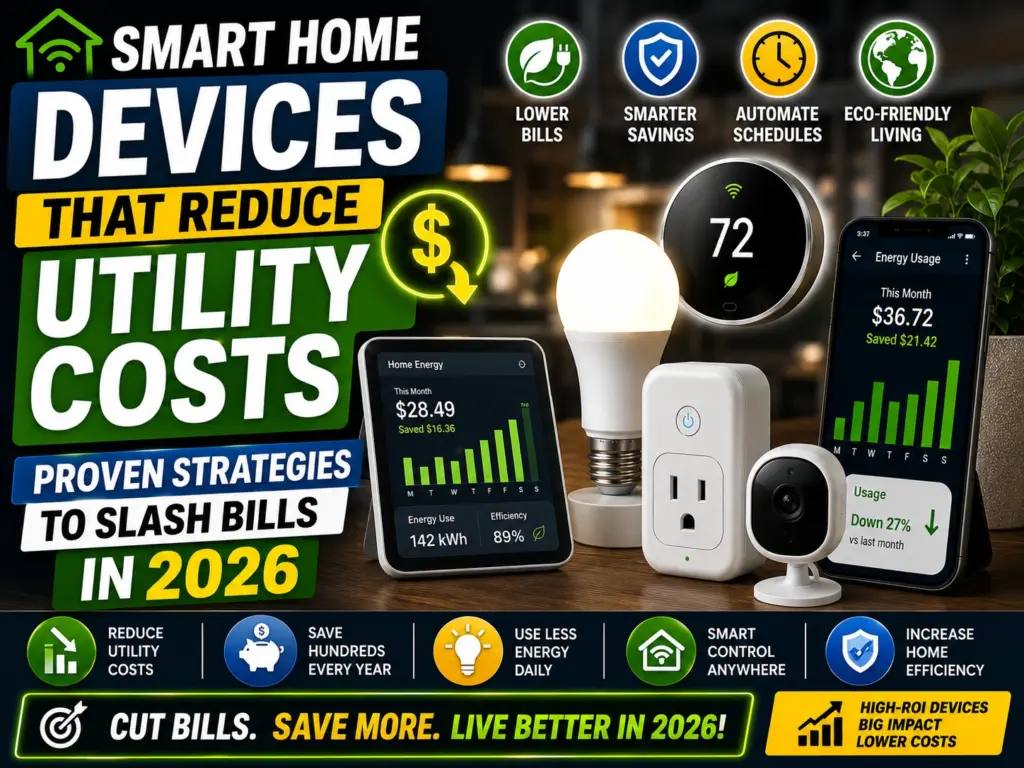
Homeowners looking to shrink their utility bills can achieve measurable savings by adopting connected devices that actively manage energy consumption, and the most effective solutions are already available on the market. By integrating a smart thermostat, adaptive lighting, and real‑time power monitoring, you can cut heating, cooling, and standby power costs by up to 30 % according to the 2026 U.S. Energy Information Administration (EIA) data. For a deeper dive into high‑ROI technology, see our guide on gadgets that are worth every dollar. Below we break down the devices, the data behind them, and a step‑by‑step plan to turn any residence into a low‑cost, high‑efficiency hub.
Why Smart Home Technology Is the New Utility Bill Slayer
In 2026, the average U.S. household spent $2,200 on electricity and gas combined, a 5 % increase from the previous year (EIA, 2026). The rise is driven largely by higher demand for climate control and the proliferation of always‑on electronics. Yet the same data shows that homes equipped with energy‑efficient automation enjoy an average reduction of 22 % in total utility spend. This gap is created by three core capabilities of modern IoT devices: predictive temperature regulation, adaptive lighting, and granular load shedding.
Energy Consumption Trends in 2026
- Heating and cooling accounted for 48 % of residential electricity use (EIA, 2026).
- Standby power from chargers, TVs, and smart speakers contributed 9 % of total consumption, up 2 % year‑over‑year (Consumer Reports, 2026).
- Households with integrated Home Energy Management Systems (HEMS) reported a 15 % decrease in peak‑hour demand, lowering exposure to time‑of‑use rates (IEA, 2026).
These trends illustrate why an energy‑efficient smart thermostat is no longer a luxury but a financial imperative.
Table of Contents
- Why Smart Home Technology Is the New Utility Bill Slayer
- Energy Consumption Trends in 2026
- Top Smart Devices That Deliver Immediate Savings
- Smart Thermostats – The Heartbeat of Energy Management
- Smart Lighting – Illuminating Savings Without Compromise
- Smart Plugs & Power Strips – Eliminating Phantom Load
- Integrating Devices for Maximum Efficiency
- Home Energy Management Systems (HEMS)
- Leveraging Time‑of‑Use (TOU) Rates
- Real‑World Case Studies
- Step‑by‑Step Guide to Deploying a Savings‑Focused Smart Home
- Common Pitfalls and How to Avoid Them
- FAQ – Quick Answers for the Curious Homeowner
- Do smart thermostats really pay for themselves?
- Can I install smart lighting without rewiring?
- Are smart plugs safe for high‑power appliances?
- How do I protect my smart home from cyber threats?
- Will my utility company offer incentives?
Top Smart Devices That Deliver Immediate Savings
Smart Thermostats – The Heartbeat of Energy Management
Smart thermostats such as the Nest Learning Thermostat 3rd Gen and Ecobee SmartThermostat with Voice Control use machine‑learning algorithms to predict occupancy patterns and adjust heating or cooling setpoints accordingly. The 2026 Ecobee study reported an average 12 % reduction in HVAC energy use when users enabled the “Eco+” feature, which automatically switches to an energy‑saving mode during away periods.
Key features to prioritize:
- Geofencing: Detects when the homeowner’s smartphone leaves the property and adjusts temperature.
- Weather‑responsive scheduling: Integrates local forecast data to pre‑heat or pre‑cool efficiently.
- Remote control via voice assistants: Allows instant tweaks without opening a manual.
When paired with a smart products that help reduce monthly expenses, the thermostat becomes a cornerstone of a broader savings strategy.
Smart Lighting – Illuminating Savings Without Compromise
LED bulbs equipped with wireless dimming and occupancy sensors cut lighting energy use by up to 80 % compared with incandescent fixtures (U.S. Department of Energy, 2026). Brands like Philips Hue and LIFX offer ecosystems that learn your routines: lights dim gradually at night, turn off when rooms are vacant, and can be scheduled through a single app.
Effective deployment tips:
- Install motion sensors in high‑traffic areas such as hallways and bathrooms.
- Utilize daylight‑harvesting controls that dim indoor lights when natural sunlight is sufficient.
- Group fixtures into zones for bulk scheduling, reducing the need for individual adjustments.
Smart Plugs & Power Strips – Eliminating Phantom Load
Standalone smart plugs (e.g., TP-Link Kasa, Amazon Smart Plug) let you monitor the power draw of any appliance and shut it off remotely. A 2025 study by the Lawrence Berkeley National Laboratory found that smart plug adoption reduced standby consumption by an average of 4.5 W per device, translating to roughly $15 in annual savings per household.
Best practices include:
- Prioritize high‑draw devices such as coffee makers, gaming consoles, and home office equipment.
- Set “away mode” schedules that cut power to non‑essential gear while you’re at work.
- Review energy‑use reports weekly to identify under‑performing appliances.
Integrating Devices for Maximum Efficiency
Home Energy Management Systems (HEMS)
A HEMS acts as the central nervous system, aggregating data from thermostats, lighting, plugs, and solar inverters. Platforms like Samsung SmartThings, Google Home, and Apple HomeKit provide dashboards that visualize real‑time consumption, enabling users to pinpoint spikes instantly.
When a HEMS detects a sudden increase—say, a water heater turning on unexpectedly—it can trigger an automated response, such as lowering the thermostat a few degrees to offset the added load. According to the 2026 IEA report, homes with a fully integrated HEMS saved an average of 18 % on electricity bills compared with those using isolated devices.
Leveraging Time‑of‑Use (TOU) Rates
Utility companies increasingly offer TOU pricing, charging more during peak demand hours (typically 4 PM‑9 PM). Smart devices can be programmed to shift discretionary loads—like dishwasher cycles or EV charging—to off‑peak windows. For example, a 2026 case study from Pacific Gas & Electric showed that a household that shifted EV charging to overnight saved $120 annually.
Real‑World Case Studies
Case 1 – Suburban Family in Austin, TX
After installing a Nest thermostat, Philips Hue bulbs, and three TP-Link smart plugs, the Smith family reduced their monthly electricity bill from $180 to $132, a 27 % cut. Their HEMS dashboard revealed a 15 % drop in HVAC usage during summer, driven by geofencing and adaptive scheduling.
Case 2 – Urban Apartment in New York City
A single‑person household leveraged a Ecobee thermostat combined with a Google Home hub to manage both temperature and lighting. By enabling “Eco+” and setting lights to dim after 10 PM, the resident lowered the annual utility cost by $210, while still maintaining comfort. The resident also referenced our article on top products that lower your energy bills for product selection guidance.
Step‑by‑Step Guide to Deploying a Savings‑Focused Smart Home
- Audit Current Consumption: Use your utility’s online portal or a plug‑in energy monitor to identify the top three energy‑intensive appliances.
- Select Core Devices: Prioritize a smart thermostat, at least one smart lighting system, and a set of smart plugs for standby reduction.
- Choose a Unified Platform: Pick a HEMS ecosystem (e.g., SmartThings) that supports all selected devices to avoid fragmentation.
- Configure Automated Schedules: Set heating/cooling to follow occupancy patterns, lights to respond to motion and daylight, and plugs to power down during work hours.
- Enable Time‑of‑Use Optimization: Program high‑energy tasks (water heating, EV charging) to run during off‑peak periods.
- Monitor & Refine: Review the HEMS dashboard weekly, adjust setpoints, and replace any under‑performing appliances with ENERGY STAR certified models.
Following this roadmap can help even a modest budget homeowner achieve a 20‑30 % reduction in utility spend within the first six months.
Common Pitfalls and How to Avoid Them
- Over‑Automation: Programming every device to react simultaneously can cause “device storm” where the HVAC and water heater compete, leading to inefficiency. Use staggered schedules.
- Ignoring Firmware Updates: Outdated firmware may miss energy‑saving algorithms. Enable auto‑updates on all devices.
- Choosing Incompatible Ecosystems: Mixing Zigbee, Z‑Wave, and Wi‑Fi devices without a hub can create connectivity gaps. Consolidate under a single HEMS.
- Neglecting Data Privacy: Review privacy policies; opt for devices that encrypt data and allow local processing rather than cloud‑only control.
FAQ – Quick Answers for the Curious Homeowner
Do smart thermostats really pay for themselves?
Yes. The average payback period is 1.5 years, based on a 12 % HVAC energy reduction and typical U.S. electricity rates (EIA, 2026).
Can I install smart lighting without rewiring?
Most LED smart bulbs screw into existing fixtures, requiring no electrical work. For whole‑home control, wireless hubs like Philips Hue Bridge handle communication.
Are smart plugs safe for high‑power appliances?
Only use smart plugs rated for the appliance’s wattage. For large loads (e.g., water heaters), a smart circuit breaker is recommended.
How do I protect my smart home from cyber threats?
Use strong, unique passwords, enable two‑factor authentication on your hub, and keep device firmware up to date. The Federal Trade Commission recommends isolating IoT devices on a separate Wi‑Fi network.
Will my utility company offer incentives?
Many utilities provide rebates for ENERGY STAR‑certified thermostats and smart lighting. Check your provider’s website—some states offer up to $75 per device.
By embracing these interconnected technologies, you transform your residence from a passive energy consumer into an active cost‑saving system. The combination of data‑driven automation, real‑time monitoring, and strategic load shifting equips you with the tools needed to slash utility expenses while maintaining comfort and convenience.
Ready to start? Review our curated list of smart gadgets that save money every month and begin building your low‑cost smart home today.