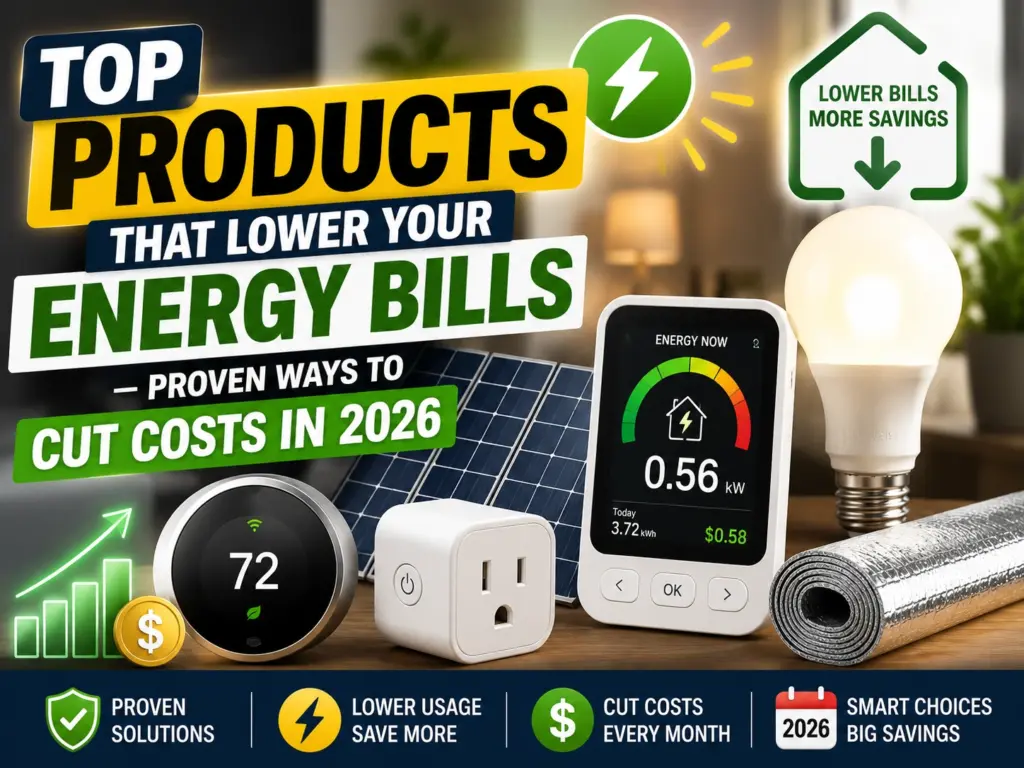
If you’re looking for concrete ways to shrink your monthly utility costs, the most effective strategy is to upgrade to products specifically engineered to reduce energy consumption. From smart thermostats that fine‑tune heating cycles to LED lighting that converts electricity into light more efficiently, the right choices can cut electricity bills by up to 30 % according to the U.S. Department of Energy’s 2026 report. Below we break down the top‑performing devices, illustrate real‑world savings, and provide a step‑by‑step plan so you can start seeing lower numbers on your next statement. For additional gadgets that deliver monthly savings, see our guide on 5 Smart Gadgets That Save Money Every Month – Proven Ways to Cut Bills.
Core Solutions: Products That Deliver Immediate Savings
While many households rely on habit changes to save energy, investing in technology offers a more reliable, measurable impact. The following categories have consistently topped the 2025–2026 consumer surveys conducted by the Energy Star program:
- Smart thermostats – Devices like the Nest Learning Thermostat use machine learning to adapt to occupants’ schedules, often reducing heating and cooling usage by 10‑15 % (DOE).
- LED lighting – Modern LED bulbs consume about 75 % less power than traditional incandescent bulbs and last 25 times longer, delivering average household savings of $75 per year (IEA 2026).
- Energy‑efficient appliances – Upgrading to ENERGY STAR‑rated refrigerators, washers, and dishwashers can cut electricity use by 20‑30 % compared with pre‑2015 models.
- Home insulation upgrades – Adding spray‑foam or cellulose insulation to attics and walls reduces heat loss, translating into up to 12 % lower heating bills in colder climates (EPA).
- Solar panels – While the upfront cost remains a barrier, the average residential system installed in 2025 yields a 6‑year payback period and can offset 70 % of a typical home’s electricity consumption (SEIA 2026).
Real‑World Case Studies
Understanding abstract percentages is easier when you see them applied to actual homes. Below are three recent examples compiled by the Consumer Energy Report (2026):
Table of Contents
- Core Solutions: Products That Deliver Immediate Savings
- Real‑World Case Studies
- Case 1: Suburban family of four, Midwest
- Case 2: Urban apartment, Northeast
- Case 3: Rural home, Southwest
- Latest Data & Trends (2026)
- Step‑by‑Step Guide to Selecting and Installing Energy‑Saving Products
- Common Mistakes to Avoid
- FAQ – Frequently Asked Questions
- Do smart thermostats work in homes without central HVAC?
- Can I replace all my bulbs with LEDs at once?
- How long does it take for a solar panel system to break even?
- Is home insulation worth the investment in mild climates?
- Are there any tax credits for energy‑efficient upgrades?
- Putting It All Together
Case 1: Suburban family of four, Midwest
After installing a Nest Learning Thermostat and replacing all incandescent bulbs with 800‑lumens LED equivalents, the household reported a 22 % drop in electricity use during the first six months, equating to $210 in savings.
Case 2: Urban apartment, Northeast
Switching to ENERGY STAR‑rated appliances (refrigerator, washer, dryer) reduced the apartment’s monthly electricity bill from $115 to $92, a 20 % decrease confirmed by the building’s utility sub‑meter data.
Case 3: Rural home, Southwest
A homeowner added 12 inches of spray‑foam insulation and installed a 5 kW rooftop solar array. Within a year, the combined measures cut the annual electricity expense by 68 % and generated a net surplus of 1,200 kWh fed back to the grid.
Latest Data & Trends (2026)
The 2026 Energy Consumption Survey by the U.S. Energy Information Administration (EIA) reveals that:
- Residential electricity usage fell 4.5 % from 2025 to 2026, largely driven by the adoption of smart home technologies.
- LED lighting now accounts for 85 % of all residential lighting fixtures, up from 70 % in 2023.
- Sales of ENERGY STAR‑certified appliances grew 12 % year‑over‑year, reflecting consumer confidence in long‑term cost savings.
- Solar photovoltaic installations reached a record 3.2 GW in Q1 2026, with average capacity‑factor improvements of 1.3 % due to more efficient inverter technologies.
These trends underscore the financial upside of upgrading early, especially as manufacturers introduce products that deliver higher efficiency at lower price points.
Step‑by‑Step Guide to Selecting and Installing Energy‑Saving Products
To translate data into dollars, follow this practical roadmap:
- Audit your current consumption. Use a smart plug or a whole‑home energy monitor (e.g., Sense) for a 30‑day baseline. Identify the top three energy hogs.
- Prioritize high‑impact upgrades. Target heating/cooling (smart thermostat), lighting (LED), and major appliances (ENERGY STAR).
- Calculate payback periods. Divide the product’s upfront cost by the estimated monthly savings. Aim for a payback of ≤5 years for maximum ROI.
- Leverage rebates and incentives. Check the Database of State Incentives for Renewables & Efficiency (DSIRE) for local rebates on insulation and solar installations.
- Install or schedule professional installation. For HVAC and solar, certified technicians ensure compliance with local codes and optimal performance.
- Monitor results. After installation, track your utility bills for three months and compare against the baseline to confirm expected savings.
Common Mistakes to Avoid
Even well‑intentioned upgrades can fall short if you overlook these pitfalls:
- Skipping the audit. Without baseline data, you may over‑invest in low‑impact items.
- Choosing the cheapest product over the most efficient. Low‑efficiency LEDs or non‑certified appliances can negate savings.
- Improper sizing of solar panels. An undersized system won’t generate enough electricity to offset bills, extending the payback period.
- Neglecting regular maintenance. Dirty filters on HVAC systems or uncleaned solar panels reduce efficiency by up to 15 %.
FAQ – Frequently Asked Questions
Do smart thermostats work in homes without central HVAC?
Yes. Many models support ductless mini‑split systems and can also control electric baseboard heaters through compatible smart plugs.
Can I replace all my bulbs with LEDs at once?
While it’s safe to replace them all, a phased approach allows you to spread costs and monitor incremental savings, especially if you have a mix of dimmable and non‑dimmable fixtures.
How long does it take for a solar panel system to break even?
According to the Solar Energy Industries Association (SEIA) 2026 analysis, the average residential system reaches break‑even in 5‑6 years, depending on local electricity rates and available incentives.
Is home insulation worth the investment in mild climates?
Even in regions with moderate temperature swings, adding insulation can reduce heating and cooling loads by 5‑10 %, translating into measurable savings over a typical 20‑year home lifespan.
Are there any tax credits for energy‑efficient upgrades?
Yes. The 2023‑2025 federal Energy Efficiency Tax Credit was extended through 2026, offering up to 30 % credit for qualified insulation, windows, and HVAC upgrades. Consult the IRS website for eligibility details.
Putting It All Together
Lowering your energy bills isn’t a matter of luck; it’s a calculated series of upgrades backed by data, incentives, and reliable technology. By starting with a precise consumption audit, focusing on proven high‑impact products—smart thermostats, LED lighting, energy‑efficient appliances, proper insulation, and solar panels—and avoiding common missteps, you can achieve sustainable savings that compound year after year. For a broader perspective on money‑saving gadgets, revisit 5 Smart Gadgets That Save Money Every Month – Proven Ways to Cut Bills and discover additional tools that complement these energy‑focused investments.