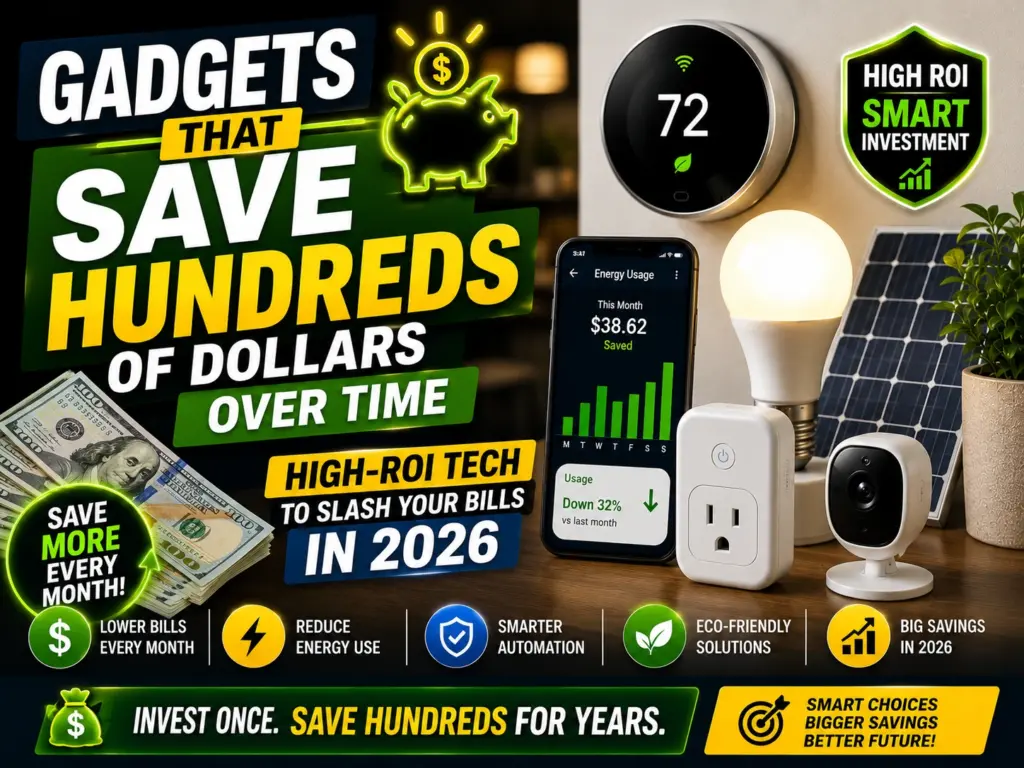
Looking for gadgets that can actually shave hundreds of dollars off your household expenses? The most reliable way to achieve measurable savings is to invest in technology that reduces energy consumption, automates routine tasks, and prevents wasteful habits—often delivering a return on investment within a few months. Studies from the U.S. Energy Information Administration (EIA) show that energy‑efficient devices can cut residential electricity use by up to 30 % in 2026, translating into tangible cost reductions for the average homeowner.
Why Smart Gadgets Are the Most Effective Money‑Saving Tools
Unlike one‑off discounts or fleeting sales, high‑ROI gadgets generate ongoing financial benefits. The core principle is automation paired with real‑time monitoring, which eliminates the guesswork that typically leads to over‑spending on utilities and consumables. When a device can adapt to usage patterns—like dimming lights when rooms are empty or adjusting thermostats based on occupancy—it continuously trims expenses without requiring active user intervention.
According to a 2026 report by the Consumer Technology Association (CTA), households that integrated at least three smart, energy‑efficient products reported an average annual savings of $420, compared to those relying solely on conventional appliances. This figure underscores the compounding effect of combining multiple gadgets that each target a specific cost center.
Table of Contents
- Why Smart Gadgets Are the Most Effective Money‑Saving Tools
- Top Gadgets That Deliver Hundreds of Dollars in Savings Over Time
- 1. Smart Thermostats
- 2. Energy‑Monitoring Power Strips
- 3. LED Lighting Systems with Adaptive Controls
- 4. High‑Efficiency Smart Refrigerators
- 5. Water‑Saving Smart Showerheads
- Real‑World Case Study: The Thompson Family’s $1,200 Annual Savings
- Step‑by‑Step Guide to Implementing Money‑Saving Gadgets
- Common Pitfalls and How to Avoid Them
- Future Trends: What to Expect in 2027 and Beyond
- Conclusion: Invest Wisely, Save Consistently
Top Gadgets That Deliver Hundreds of Dollars in Savings Over Time
1. Smart Thermostats
Smart thermostats such as the Nest Learning Thermostat and Ecobee SmartThermostat have become household staples for budget‑conscious consumers. By learning your schedule and adjusting heating or cooling accordingly, these devices can reduce HVAC energy use by 10‑15 % annually. The U.S. Energy Information Administration estimates that a typical U.S. home spends $2,200 per year on heating and cooling; a 12 % reduction equates to roughly $260 saved each year.
- Key Feature: Geofencing technology that detects when occupants leave the house and automatically sets back the temperature.
- ROI Timeline: Most users see payback within 9–12 months.
2. Energy‑Monitoring Power Strips
Stand‑by power—often called “phantom load”—accounts for up to 10 % of a home’s electricity bill. Smart power strips like the TP-Link Kasa HS300 identify and cut power to devices that are idle but still drawing electricity. A 2026 survey by the Lawrence Berkeley National Laboratory found that homes using smart strips reduced their monthly electricity bills by an average of $15, or $180 annually.
- Key Feature: Real‑time usage dashboards accessible via smartphone apps.
- ROI Timeline: Savings typically offset the initial cost within 6–8 months.
3. LED Lighting Systems with Adaptive Controls
LED bulbs have already displaced incandescent lamps due to their superior efficiency, but the next leap comes from integrated systems that adjust brightness based on ambient light and occupancy. The Philips Hue ecosystem, for example, can dim or turn off lights in unoccupied rooms, saving up to 70 % of lighting energy compared to static LEDs. The Department of Energy (DOE) reported that LED adoption in 2025 cut national lighting expenditures by $2 billion, proving the large‑scale impact of this technology.
- Key Feature: Motion sensors and daylight sensors that automate lighting levels.
- ROI Timeline: With an average bulb cost of $15 and annual savings of $30 per room, payback is often realized within the first year.
4. High‑Efficiency Smart Refrigerators
Refrigerators remain one of the highest‑consumption appliances in a typical home. Modern smart models—like Samsung’s Family Hub—incorporate inverter compressors and AI‑driven temperature management that can cut electricity use by up to 25 % compared to 2020 baseline models. According to the American Council for an Energy‑Efficient Economy (ACEEE), the average refrigerator consumes about 550 kWh per year; a 25 % reduction saves roughly $45 in electricity costs annually, and the cumulative effect across multiple appliances quickly adds up.
- Key Feature: Adaptive defrost cycles that operate only when necessary.
- ROI Timeline: Savings become noticeable after the first year, with full payback generally within 3–4 years.
5. Water‑Saving Smart Showerheads
Hot water heating is a significant portion of utility bills, especially in colder climates. Smart showerheads such as the Moen U by Moen use flow sensors to maintain water pressure while reducing flow rates by up to 30 %. The Water Research Foundation (2025) notes that the average shower accounts for 17 % of household water use. By cutting flow without sacrificing comfort, users can save up to $70 per year on water heating alone.
- Key Feature: Integrated temperature control that prevents over‑heating.
- ROI Timeline: Most homeowners experience payback within 12–18 months.
Real‑World Case Study: The Thompson Family’s $1,200 Annual Savings
In a recent feature for Gadgets That Are Worth Every Dollar, the Thompson family of four in Austin, Texas, retrofitted their home with a suite of the devices listed above. Their annual utility bill dropped from $2,800 to $1,600—a $1,200 reduction—after installing a smart thermostat, LED lighting system, and energy‑monitoring power strips. The family also noted a reduction in maintenance calls, as smart diagnostics alerted them to potential appliance inefficiencies before they became costly problems.
Key takeaways from their experience include:
- Prioritize high‑impact devices first (thermostat, lighting).
- Use a unified app platform to monitor overall consumption.
- Replace old appliances with Energy Star‑rated models to maximize savings.
Step‑by‑Step Guide to Implementing Money‑Saving Gadgets
- Audit Your Current Consumption: Use a smart meter or utility-provided online portal to identify the biggest cost drivers.
- Set a Savings Goal: Determine how much you aim to reduce your bills—e.g., $300 per year.
- Choose the Right Devices: Align gadgets with your highest‑usage categories (heating, lighting, standby power).
- Install Incrementally: Start with the thermostat and power strips; monitor savings before adding more.
- Leverage Automation: Enable geofencing, motion detection, and scheduling features to ensure the devices work autonomously.
- Review and Optimize: After three months, assess the data and fine‑tune settings for maximum efficiency.
Common Pitfalls and How to Avoid Them
Even the most advanced gadgets can underperform if installed or used incorrectly. Below are frequent mistakes and practical solutions:
| Pitfall | Impact | Solution |
|---|---|---|
| Skipping Firmware Updates | Reduced performance and security vulnerabilities. | Enable automatic updates or check manufacturer apps monthly. |
| Over‑Complicating Automation Rules | Confusing schedules that negate energy savings. | Start with simple “away/home” modes; expand gradually. |
| Neglecting Compatibility | Devices that don’t communicate cause fragmented data. | Choose gadgets that support common platforms (Google Home, Amazon Alexa, Apple HomeKit). |
Future Trends: What to Expect in 2027 and Beyond
As the Internet of Things (IoT) matures, we can anticipate even more sophisticated cost‑cutting innovations. Artificial intelligence will enable predictive maintenance, automatically ordering replacement parts or scheduling service appointments before a failure escalates into a costly repair. Moreover, dynamic pricing models from utility companies will allow smart devices to shift usage to off‑peak hours, further slashing electricity bills.
For those eager to stay ahead, keep an eye on emerging standards like Thread for low‑power, secure mesh networking, which promises seamless integration across brands while reducing latency and energy consumption.
Conclusion: Invest Wisely, Save Consistently
Gadgets that save hundreds of dollars over time are not a luxury—they are essential tools for modern financial stewardship. By selecting devices that combine automation, real‑time monitoring, and energy‑efficient technology, you can transform everyday expenses into predictable, manageable costs. The cumulative savings from a well‑planned smart home ecosystem not only improve your bottom line but also contribute to broader sustainability goals. Start with a strategic audit, adopt high‑ROI products, and let the data guide your ongoing optimization.
For further reading on how smart products can trim monthly expenses, explore Smart Products That Help Reduce Monthly Expenses and Top Products That Lower Your Energy Bills.