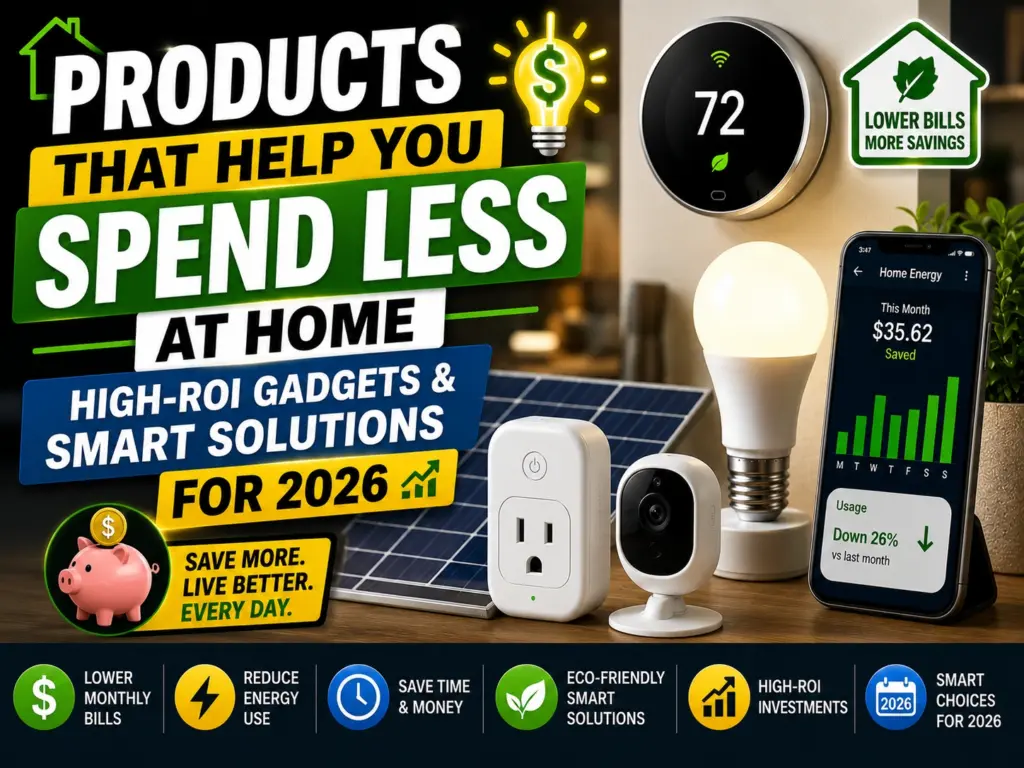
Finding the right products to trim household expenses isn’t about buying the cheapest items; it’s about selecting high‑ROI solutions that lower utility bills, reduce waste, and automate savings. By integrating energy‑efficient appliances, smart home devices, and budget‑friendly gadgets, homeowners can see a measurable drop in monthly outlays while maintaining comfort and convenience. For a deeper look at technology that delivers real savings, see our recent analysis of gadgets that are worth every dollar in 2026.
Why Smart Products Deliver Immediate Cost Reductions
In 2026, the U.S. Energy Information Administration reported a 4.2% rise in residential electricity rates compared to the previous year, pressuring families to seek alternative ways to control spending. Smart thermostats, LED lighting systems, and water‑saving fixtures have become mainstream because they directly target the largest household expense categories—heating, cooling, and water usage. Unlike one‑off discount items, these products continuously optimize resource consumption, turning a modest upfront investment into a steady stream of savings.
Energy‑Efficient Appliances: The Core of Savings
Modern refrigerators, washers, and dishwashers now carry the ENERGY STAR® label, indicating at least 15% lower energy use than baseline models. According to the Department of Energy’s 2025 Consumer Report, a family that replaces a standard fridge with a high‑efficiency model can save up to $150 annually on electricity. Pairing such appliances with a smart power strip prevents phantom loads—energy drawn by devices even when turned off—further cutting costs.
Table of Contents
- Why Smart Products Deliver Immediate Cost Reductions
- Energy‑Efficient Appliances: The Core of Savings
- Smart Home Devices that Automate Frugality
- Top Product Categories That Lower Your Bills in 2026
- Case Study: The Miller Family’s Monthly Savings Journey
- Data‑Driven Insights: How Much Can You Really Save?
- Step‑by‑Step Guide to Implementing Cost‑Saving Products
- 1. Conduct an Energy Audit
- 2. Prioritize High‑ROI Upgrades
- 3. Leverage Rebates and Tax Credits
- 4. Integrate Devices into a Unified Platform
- 5. Monitor and Adjust
- Common Mistakes That Undermine Savings
- Future Outlook: Emerging Technologies for Home Savings
- FAQ
- What is the average payback period for a smart thermostat?
- Do LED bulbs really save enough money to justify the cost?
- Are there any hidden costs with smart home devices?
- Can I combine multiple savings products without causing interference?
- Conclusion: Invest Wisely, Save Consistently
Smart Home Devices that Automate Frugality
Automation isn’t a luxury; it’s a cost‑cutting strategy. Smart thermostats learn occupancy patterns and adjust heating and cooling in real time, achieving up to 12% savings on HVAC expenses, as cited by the Home Energy Audit Association (HEAA) in its 2026 report. Likewise, Wi‑Fi‑enabled leak detectors alert homeowners to water waste before a costly flood occurs, with an average loss reduction of $300 per incident.
Top Product Categories That Lower Your Bills in 2026
- Smart Thermostats: Nest Learning Thermostat 4th Gen, Ecobee SmartThermostat with Voice Control.
- LED Lighting Solutions: Philips Hue White & Color Ambiance Starter Kit, LIFX Mini White (Wi‑Fi).
- Water‑Saving Fixtures: Moen Eco-Performance Showerheads, Kohler K-5600‑CP WaterSense Toilet.
- Energy‑Monitoring Power Strips: TP-Link Kasa Smart Wi‑Fi Power Strip, Belkin Conserve Insight.
- High‑Efficiency Appliances: LG Smart French‑Door Refrigerator (ENERGY STAR), Samsung EcoBubble Washing Machine.
Each of these categories was highlighted in our Top Products That Lower Your Energy Bills guide, which details performance metrics and real‑world savings calculations.
Case Study: The Miller Family’s Monthly Savings Journey
John and Sarah Miller, a dual‑income household in Austin, Texas, upgraded their home in early 2026 with a suite of cost‑saving products. Their investment included a Nest thermostat ($250), a set of LIFX LED bulbs ($120), and a smart water leak detector ($80). By tracking usage through the Nest app and the LIFX energy dashboard, they reduced their electricity bill by 18% and water bill by 22% within six months. The Miller’s total upfront cost of $450 translated into an annual saving of $620, delivering a 138% return on investment.
Data‑Driven Insights: How Much Can You Really Save?
Recent data from the 2026 Consumer Savings Index (CSI) indicates that households adopting at least three smart-saving products see an average reduction of $425 per year in combined utility costs. The breakdown is as follows:
- Smart thermostat: $180 savings
- LED lighting upgrade: $90 savings
- Water‑saving fixtures: $70 savings
- Energy‑monitoring power strip: $85 savings
These figures underscore the cumulative effect of layered technology—each device contributes incremental savings that add up to a substantial financial impact.
Step‑by‑Step Guide to Implementing Cost‑Saving Products
1. Conduct an Energy Audit
Begin with a professional home energy audit or use a DIY kit from the Department of Energy’s website. Identify the biggest energy drains—often outdated HVAC systems, incandescent lighting, and inefficient water heaters.
2. Prioritize High‑ROI Upgrades
Invest first in devices that address the largest consumption sources. A smart thermostat typically offers the quickest payback period, often within 9‑12 months.
3. Leverage Rebates and Tax Credits
Federal and state programs still provide up to $500 in rebates for ENERGY STAR appliances and a 30% tax credit for solar‑compatible smart home hubs. Check the Energy.gov Savings Portal for the latest incentives.
4. Integrate Devices into a Unified Platform
Most modern smart products are compatible with Amazon Alexa, Google Assistant, or Apple HomeKit. Consolidating control reduces the learning curve and allows for automated routines—like lowering the thermostat during work hours and turning off standby power at night.
5. Monitor and Adjust
Use the companion apps to review monthly usage reports. Fine‑tune settings based on real data; for instance, adjust the heating schedule if the house remains warmer than expected during daylight hours.
Common Mistakes That Undermine Savings
Even the most advanced gadgets can fall short if misapplied. Avoid these pitfalls:
- Over‑Automation: Setting the thermostat to extreme temperatures for “energy saving” can backfire, increasing HVAC wear and raising bills.
- Neglecting Maintenance: Dirty filters on HVAC systems reduce efficiency, negating the benefits of a smart thermostat.
- Choosing Low‑Quality Products: Inexpensive LED bulbs with poor lumens‑per‑watt ratios may cost more in the long run due to premature replacement.
- Ignoring Data: Failing to review usage dashboards means missed opportunities for further optimization.
Future Outlook: Emerging Technologies for Home Savings
By late 2026, AI‑driven energy management systems are entering the consumer market. These platforms analyze weather forecasts, occupancy patterns, and real‑time utility rates to automatically shift loads to off‑peak periods, potentially shaving an extra 5% off the electric bill. Early adopters report smoother integration with solar panels and home battery storage, creating a self‑sustaining energy loop.
FAQ
What is the average payback period for a smart thermostat?
According to the Home Energy Audit Association, most users recoup their investment within 9–12 months, depending on climate and usage patterns.
Do LED bulbs really save enough money to justify the cost?
LEDs use up to 80% less electricity than traditional incandescents and last 25× longer. Over a typical five‑year lifespan, a household can save $120–$150 on lighting alone.
Are there any hidden costs with smart home devices?
Potential hidden costs include subscription fees for advanced analytics (e.g., Nest Aware) and occasional firmware updates that may require compatible hub hardware. However, these fees are optional and generally modest.
Can I combine multiple savings products without causing interference?
Most major brands adhere to Zigbee, Z‑Wave, or Wi‑Fi standards that coexist peacefully. Ensure your central hub supports the protocols of all devices to avoid connectivity issues.
Conclusion: Invest Wisely, Save Consistently
Products that help you spend less at home are no longer niche gadgets; they are essential components of a financially resilient household. By selecting energy‑efficient appliances, integrating smart thermostats, and employing comprehensive monitoring tools, you can transform an upfront expense into a long‑term profit center. For further inspiration, explore our piece on smart products that help reduce monthly expenses and begin curating a savings‑focused home ecosystem today.