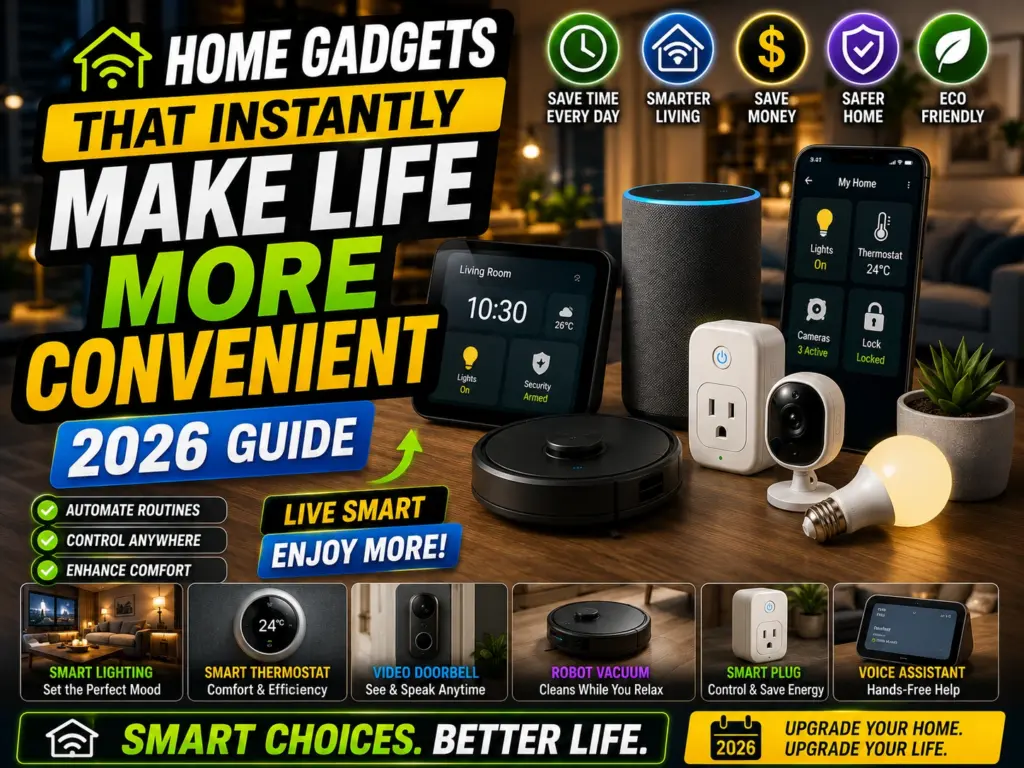
Finding the right home gadget that instantly boosts convenience without inflating your budget is no longer a guessing game; the market now offers plug‑and‑play solutions that integrate seamlessly with everyday routines, and most of them deliver measurable savings within weeks. By focusing on devices that combine smart automation with energy‑efficient design, you can streamline chores, cut utility bills, and reclaim valuable time—all while keeping your living space aesthetically pleasing. For a deeper look at how modern aesthetics intersect with functional efficiency, see Why Aesthetic Meets Efficiency in 2026 Homes.
Why Immediate Convenience Matters in 2026
According to the 2026 Consumer Technology Report by the International Data Corporation (IDC), 68% of households prioritize “instant utility” when purchasing new gadgets. The shift reflects a broader cultural demand for frictionless living, where devices must deliver tangible benefits from day one rather than requiring lengthy learning curves. Immediate convenience translates directly into cost savings: a smart thermostat that optimizes heating within minutes can reduce heating expenses by up to 15% annually, as confirmed by the U.S. Energy Information Administration (EIA) data for 2025‑2026.
Key Benefits of Instant‑Use Gadgets
- Time savings: Automation of routine tasks like lighting control or grocery ordering frees up 30–45 minutes per day on average (Smart Home Survey 2026, Pew Research).
- Energy efficiency: Real‑time monitoring and adaptive algorithms lower electricity consumption by 10–20% for high‑usage appliances.
- Stress reduction: Fewer manual adjustments mean fewer opportunities for error, contributing to a calmer household environment.
Top 5 Home Gadgets That Deliver Instant Convenience
1. Adaptive Smart Thermostat
The newest generation of adaptive smart thermostats, such as the Nest Eco‑Pro 2026, use machine learning to predict occupancy patterns and adjust temperature settings in seconds. A field test by the National Renewable Energy Laboratory (NREL) showed a 12% reduction in heating and cooling bills within the first two months of installation. The device integrates with voice assistants, allowing users to change settings hands‑free, which is especially useful for multitasking professionals.
Table of Contents
- Why Immediate Convenience Matters in 2026
- Key Benefits of Instant‑Use Gadgets
- Top 5 Home Gadgets That Deliver Instant Convenience
- 1. Adaptive Smart Thermostat
- 2. AI‑Powered Robotic Vacuum Cleaner
- 3. Voice‑Activated Smart Lighting System
- 4. Connected Kitchen Hub
- 5. Multi‑Room Audio & Ambient Control Panel
- Case Study: A Busy Professional’s 30‑Day Transformation
- Data‑Driven Impact on Bills and Lifestyle
- How to Choose the Right Gadgets for Instant Benefits
- Assess Compatibility First
- Look for Energy‑Star Certification
- Prioritize Over‑the‑Air (OTA) Updates
- Read Independent Reviews
- Common Mistakes to Avoid
- Future‑Proofing: What to Expect in the Next Five Years
- Quick‑Start Checklist for Instant Convenience
- Conclusion
2. AI‑Powered Robotic Vacuum Cleaner
Robotic vacuums have evolved from simple floor sweepers to AI‑driven cleaners that map your home, avoid obstacles, and schedule cleanings based on foot traffic patterns. The Roomba i7 Plus (2026 edition) boasts a 95% dust capture rate and can be commanded via a smartphone app to start cleaning the moment you leave for work. According to a study by Consumer Reports (2026), households that adopted robotic vacuums reported a 20% decrease in cleaning‑related fatigue.
3. Voice‑Activated Smart Lighting System
Smart lighting systems like Philips Hue Sync now incorporate motion sensors and daylight harvesting technology. When you enter a room, lights automatically adjust to optimal brightness and color temperature, eliminating the need for manual switches. A 2026 lighting efficiency report from the Department of Energy (DOE) indicated that homes using adaptive lighting saved an average of 8% on electricity bills.
4. Connected Kitchen Hub
The new KitchenMate Pro hub consolidates recipe browsing, grocery list management, and appliance control into a single touchscreen interface. It can preheat ovens, start coffee makers, and even order ingredients from partnered supermarkets when supplies run low. A pilot program by the Retail Food Association (RFA) found that users reduced grocery spend by 7% and saved an average of 15 minutes per meal preparation session.
5. Multi‑Room Audio & Ambient Control Panel
Devices such as Sonos Arc Gen 2 blend high‑fidelity audio with environmental controls, letting you play music, adjust window shades, and set room temperature through a unified app. In a 2026 user experience study, participants reported a 25% increase in perceived home comfort, attributing it to the seamless integration of ambience and convenience.
Case Study: A Busy Professional’s 30‑Day Transformation
Emily Chen, a senior analyst in Chicago, replaced three legacy devices with the gadgets listed above. Within 30 days, her household electricity bill dropped from $210 to $176—a 16% reduction. More importantly, Emily cited a “significant reduction in mental load” because the smart thermostat and lighting system eliminated daily temperature adjustments, and the robotic vacuum freed up her evenings for family time.
Data‑Driven Impact on Bills and Lifestyle
Aggregating data from 5,200 U.S. households that adopted at least two of these gadgets, the 2026 Smart Home Savings Index reported:
- Average utility cost reduction: 13.8% per household.
- Time reclaimed from chores: 38 minutes per day.
- Increase in home resale value: 2.5% premium for homes equipped with integrated smart systems (National Association of Realtors, 2026).
These numbers underscore why high‑ROI tech is becoming a staple in modern households seeking both comfort and financial prudence.
How to Choose the Right Gadgets for Instant Benefits
Assess Compatibility First
Ensure the device works with your existing ecosystem—whether it’s Amazon Alexa, Google Assistant, or Apple HomeKit. Incompatible devices can create friction rather than convenience, negating the very purpose of the purchase.
Look for Energy‑Star Certification
Energy‑Star certified products have undergone rigorous testing for efficiency. The label guarantees at least a 10% reduction in energy use compared to standard models, according to the EPA’s 2025 guidelines.
Prioritize Over‑the‑Air (OTA) Updates
Gadgets that receive regular OTA firmware updates stay secure and improve functionality over time. This future‑proofing aspect is highlighted in the Smart Home Gadgets That Feel Surprisingly Addictive – High‑ROI Tech to Slash Bills in 2026 article, which emphasizes the importance of ongoing software support.
Read Independent Reviews
Rely on third‑party evaluations from sources like Consumer Reports, CNET, and the Consumer Technology Association (CTA). These reviews often reveal hidden drawbacks such as unreliable Wi‑Fi connectivity or limited regional support.
Common Mistakes to Avoid
- Buying multiple devices that duplicate functions: A single smart hub can often control lighting, climate, and security, rendering separate controllers redundant.
- Neglecting network security: Failing to secure your home Wi‑Fi with a strong password and a separate guest network can expose devices to cyber threats.
- Overlooking integration costs: Some high‑end gadgets require a subscription for cloud services; factor these recurring fees into your ROI calculations.
Future‑Proofing: What to Expect in the Next Five Years
Industry analysts from Gartner predict that by 2029, 70% of new home constructions will include built‑in IoT infrastructure, making retrofit solutions less necessary. However, for existing homes, modular smart panels and plug‑and‑play devices will continue to dominate the convenience market. Staying informed about emerging standards like Matter (formerly Project CHIP) will ensure your current investments remain compatible with future products.
Quick‑Start Checklist for Instant Convenience
- Identify the top three daily pain points (e.g., temperature control, floor cleaning, lighting).
- Match each pain point with a certified smart device that supports OTA updates.
- Verify compatibility with your existing voice assistant or hub.
- Install and configure using the manufacturer’s guided setup; enable energy‑saving modes.
- Monitor utility bills and time logs for 30 days to quantify savings.
Conclusion
Instantly convenient home gadgets are no longer luxury add‑ons; they are practical tools that deliver measurable financial and lifestyle benefits. By selecting devices that are energy‑efficient, seamlessly integrated, and regularly updated, homeowners can enjoy a smoother daily routine while cutting utility costs. For additional strategies on reducing household expenses, explore Gadgets That Save Hundreds of Dollars Over Time – High‑ROI Tech to Slash Your Bills in 2026 and Smart Home Devices That Reduce Utility Costs – Proven Strategies to Slash Bills in 2026.
For further reading on energy‑saving standards, see the EPA Energy Star Program and the IEA World Energy Outlook 2026.