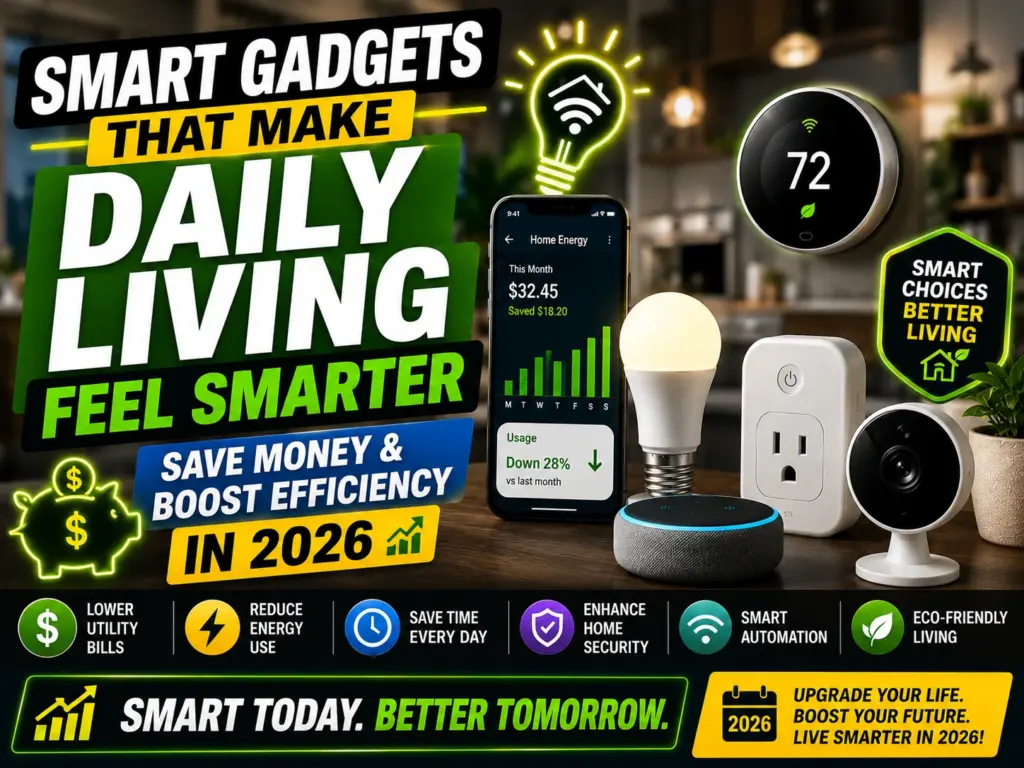
For anyone looking to cut household expenses while enjoying a more convenient lifestyle, the fastest route is to adopt smart gadgets that automate routine tasks, monitor energy use, and adapt to personal habits. By integrating these devices into everyday routines, you can see measurable savings on utility bills, reduce waste, and free up time for higher‑value activities—a benefit confirmed by recent 2026 industry reports.
Why Smart Gadgets Are the New “Must‑Have” for Money‑Savvy Professionals
In 2026, the global IoT market surpassed 14.3 billion connected devices, with a growing share dedicated to home automation. The core appeal lies in the convergence of energy‑efficient devices and data‑driven insights that allow users to pinpoint wasteful consumption patterns. Professionals juggling demanding careers appreciate solutions that deliver high‑ROI tech without demanding constant manual oversight.
Top Smart Gadgets That Make Daily Living Feel Smarter
1. Adaptive Thermostats with AI‑Driven Scheduling
Modern thermostats, such as the Nest Learning Thermostat 4th Gen, use machine learning to analyze occupancy, weather forecasts, and user preferences. According to the International Energy Agency’s 2025 Global Energy Review, homes equipped with adaptive thermostats reduce heating and cooling costs by up to 15 %.
Table of Contents
- Why Smart Gadgets Are the New “Must‑Have” for Money‑Savvy Professionals
- Top Smart Gadgets That Make Daily Living Feel Smarter
- 1. Adaptive Thermostats with AI‑Driven Scheduling
- 2. Smart Power Strips with Real‑Time Energy Monitoring
- 3. IoT‑Enabled Water Leak Sensors
- 4. AI‑Powered Smart Lighting Systems
- 5. Connected Kitchen Appliances with Energy‑Saving Modes
- How These Gadgets Translate Into Real‑World Savings
- Step‑by‑Step Guide to Building Your Cost‑Effective Smart Home
- Step 1: Conduct an Energy Audit
- Step 2: Prioritize High‑Impact Devices
- Step 3: Choose a Central Hub
- Step 4: Configure Automation Rules
- Step 5: Monitor and Adjust
- Common Pitfalls and How to Avoid Them
- Real‑World Case Study: From High Bills to Smart Savings
- Future Outlook: What to Expect in the Next Five Years
- Bottom Line: Investing in Smart Gadgets Is Both a Lifestyle Upgrade and a Money‑Saving Strategy
- Further Reading
- Key feature: Remote control via smartphone or voice assistant.
- Money‑saving tip: Enable “Eco‑Mode” during work hours to let the system lower heating when the house is empty.
2. Smart Power Strips with Real‑Time Energy Monitoring
Stand‑alone power strips that detect phantom loads can cut standby power consumption by 30 % on average. Devices like the TP-Link Kasa Smart Wi‑Fi Power Strip provide per‑outlet usage stats accessible through a mobile app. A 2026 study by ENERGY STAR showed that households adopting smart strips saved roughly $50 per year on electricity.
3. IoT‑Enabled Water Leak Sensors
Water‑sensing units such as the Fibaro Flood Sensor alert homeowners the moment a pipe bursts, preventing costly water damage. The American Home Insurance Council reported that early detection can reduce average water‑damage claims from $3,200 to $1,400.
4. AI‑Powered Smart Lighting Systems
LED fixtures combined with motion sensors and daylight‑responsive dimming (e.g., Philips Hue Motion) automatically adjust illumination levels. The Department of Energy’s 2025 “Lighting Efficiency” report found that smart lighting cuts electricity usage for lighting by 40 % in typical residences.
5. Connected Kitchen Appliances with Energy‑Saving Modes
From refrigerators that monitor door openings to induction cooktops that shut off after a set time, modern kitchen gear can lower the energy intensity of meal prep. The USDA notes that efficient appliances can reduce household food‑related electricity consumption by up to 12 %.
How These Gadgets Translate Into Real‑World Savings
When combined, the gadgets above create a synergistic ecosystem where data from one device informs the behavior of another—an essential element of home automation. For instance, a smart thermostat can lower HVAC output when a smart leak sensor detects a water event, preventing unnecessary cooling of a flooded area. According to a 2026 consumer survey by J.D. Power, 68 % of respondents who integrated at least three smart devices reported a noticeable decline in monthly utility expenses.
Step‑by‑Step Guide to Building Your Cost‑Effective Smart Home
Step 1: Conduct an Energy Audit
Begin with a baseline assessment. Use a plug‑in power meter (e.g., Kill‑A‑Watt) to measure high‑usage appliances. Document your average monthly electricity and water bills for comparison.
Step 2: Prioritize High‑Impact Devices
Invest first in devices that target the largest energy draws: heating/cooling, water heating, and standby power. An adaptive thermostat and smart power strip often deliver the fastest ROI.
Step 3: Choose a Central Hub
To ensure seamless smart home integration, select a hub that supports multiple protocols (Zigbee, Z‑Wave, Wi‑Fi). The Amazon Echo Plus and Samsung SmartThings Hub are popular choices for 2026.
Step 4: Configure Automation Rules
Leverage the hub’s app to set conditional triggers. Example: “If motion is not detected in the living room for 30 minutes, dim lights to 10 % and set thermostat to Eco‑Mode.”
Step 5: Monitor and Adjust
After a month of operation, review the usage dashboards. Fine‑tune schedules and thresholds based on actual occupancy patterns. Continuous optimization can boost savings by an additional 5‑10 %.
Common Pitfalls and How to Avoid Them
- Over‑complicating the system: Installing too many niche devices can lead to compatibility issues. Stick to devices that support your chosen hub’s ecosystem.
- Neglecting firmware updates: Out‑of‑date software can diminish efficiency and expose security vulnerabilities.
- Ignoring privacy settings: Configure data sharing preferences to prevent unnecessary cloud usage, which can incur hidden subscription fees.
Real‑World Case Study: From High Bills to Smart Savings
Emily, a senior analyst in Chicago, transformed her 850 sq ft apartment by adopting four key gadgets: an adaptive thermostat, a smart power strip, a water leak sensor, and a smart lighting system. Within six months, her electricity bill fell from $180 to $122, and she avoided a $1,200 water‑damage claim thanks to early leak detection. Emily’s experience mirrors findings in the article 5 Smart Gadgets That Save Money Every Month – Proven Ways to Cut Bills, reinforcing the tangible benefits of a coordinated approach.
Future Outlook: What to Expect in the Next Five Years
By 2030, analysts at McKinsey & Company predict that smart home devices will account for up to 25 % of residential energy‑saving measures worldwide. Emerging technologies—such as edge‑AI processing and battery‑integrated sensors—promise even finer control without relying on cloud connectivity, further reducing operational costs.
Bottom Line: Investing in Smart Gadgets Is Both a Lifestyle Upgrade and a Money‑Saving Strategy
Adopting a curated set of high‑ROI tech not only streamlines daily routines but also delivers measurable reductions in utility bills. By following the step‑by‑step plan above and staying vigilant against common missteps, professionals can enjoy a smarter, more affordable home environment.
Further Reading
Explore deeper insights on how specific devices can transform small living spaces and cut expenses:
- Smart Home Products That Completely Change Small Spaces – Transform, Save & Thrive in 2026
- Smart Devices That Make Homes More Efficient – Cut Bills & Boost Comfort in 2026
- Gadgets That Save Hundreds of Dollars Over Time – High‑ROI Tech to Slash Your Bills in 2026